
Encrypting Patient Data When the Server Must Not Hold the Key
Field-level AES-256-GCM with clinic-held keys, blind indexes, a canary against wrong keys, age-encrypted backups the server can't read, and what a disaster-recovery fire drill actually taught us.
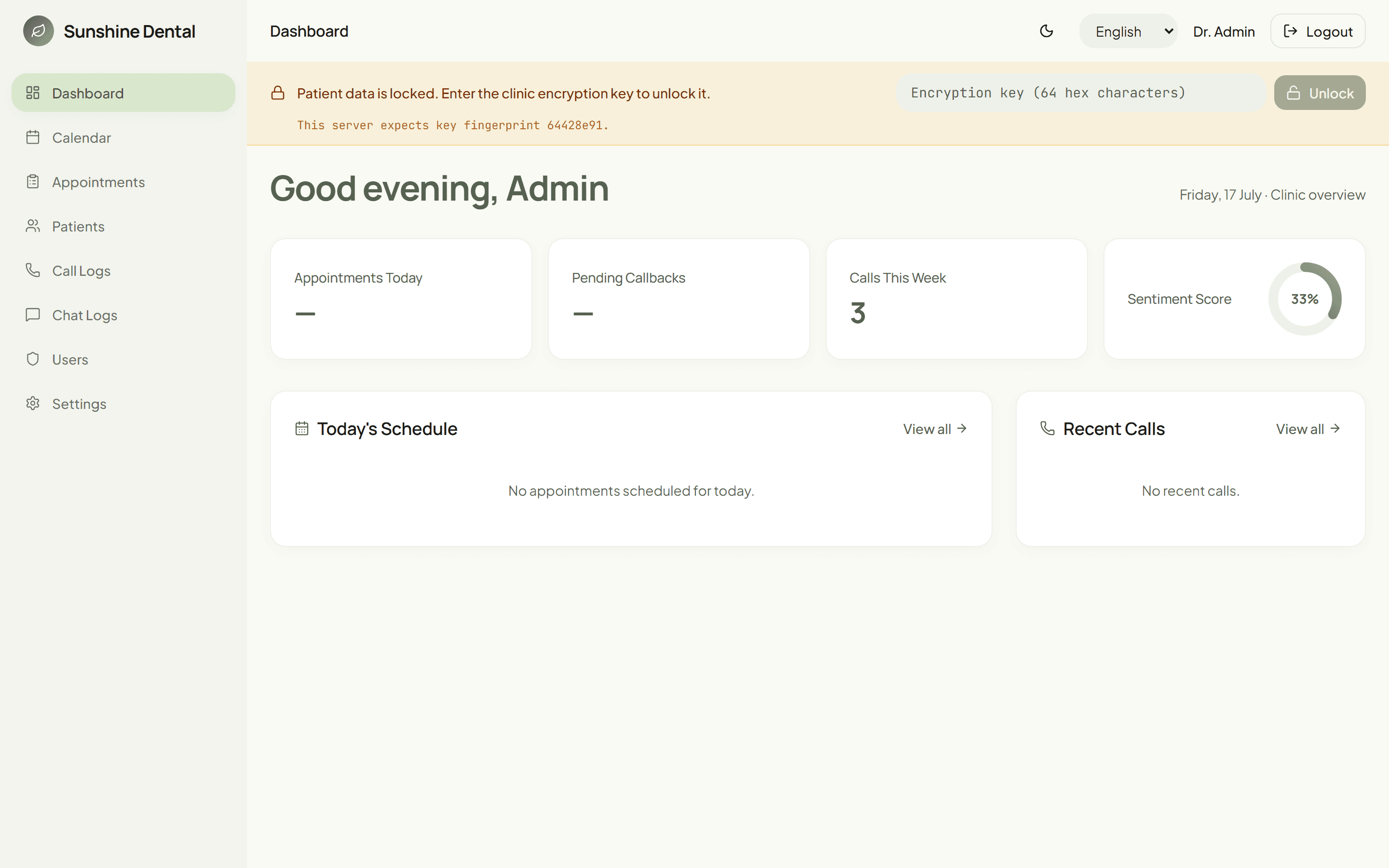
When I added an AI receptionist (voice + chat) to a dental-clinic app, I ended up storing exactly the data you least want to leak: names, phone numbers, appointment reasons, full call and chat transcripts. This post is the complete, working design I landed on for field-level encryption where the vendor cannot read the data, plus the backup and disaster-recovery machinery that has to exist before you can honestly claim any of it. It's written for engineers; everything below is running in production on a €4 Hetzner VPS.
The one-sentence design goal, and the constraint that shapes everything else:
The clinic holds the encryption key. The server — and therefore I, the vendor — never stores it.
Everything interesting in this post is a consequence of that sentence.
What encryption at rest actually buys you
Be precise about the threat model, because "encrypted" is doing a lot of marketing work in most SaaS copy. Field-level encryption with a clinic-held key protects against:
- a stolen database dump (SQL injection, leaked backup, misconfigured storage bucket),
- a stolen disk or decommissioned hardware,
- your DB provider reading your tables,
- you, the vendor, casually browsing customer PII.
It does not protect against a malicious root on the live box while the app is unlocked — the key sits in process memory, and root can read process memory. That's process, not math. Say so in your DPA instead of over-claiming; the honest version is still a strong story.
Layer 1: field-level AES-256-GCM
Ciphertext values are self-describing strings with a version prefix:
enc:v1:<base64(iv || ciphertext || gcm-tag)>
The prefix makes encryption idempotent (encrypting an already-encrypted value is a no-op) and makes migration windows survivable (plaintext rows pass through the decrypt path unchanged until a migration script catches them):
export function encryptString(plaintext: string): string {
  if (isEncrypted(plaintext)) return plaintext   // double-encryption impossible
  assertUnlocked()
  return encryptWith(keys!.dataKey, plaintext)
}

export function decryptString(value: string): string {
  if (!isEncrypted(value)) return value          // pre-migration rows pass through
  assertUnlocked()
  return decryptWith(keys!.dataKey, value)
}
Two deliberate choices here:
One master key, HKDF subkeys. The clinic's 32-byte master key (64 hex chars, openssl rand -hex 32) is never used directly. HKDF derives a dataKey (AES-GCM) and an indexKey (HMAC, see below), so the two uses can never collide cryptographically.
Encryption is explicit in the service layer, not a Prisma middleware. A $extends hook that transparently encrypts everything sounds elegant and is a debugging nightmare — you lose the ability to reason about which queries touch ciphertext, and every raw query becomes a landmine. Instead there's a single ENCRYPTED_FIELDS map and explicit encryptRow('patient', {...}) / decryptRow(...) calls at the boundaries. Grep-ability is a security feature.
Layer 2: searching what you can't read
Encrypted columns break two things you actually need: exact lookups and substring search.
Exact phone lookup (dedupe: "does this caller already exist?") uses a blind index — a keyed HMAC over the normalized phone number stored in its own column:
export function blindIndex(normalized: string): string {
  assertUnlocked()
  return createHmac('sha256', keys!.indexKey)
    .update(normalized, 'utf8')
    .digest('base64url')
}
Deterministic per key, so WHERE phoneIndex = ? works over ciphertext; without the key the index is neither reversible nor even testable against guesses (unlike a plain hash, you can't brute-force candidate phone numbers without the HMAC key). Normalization matters more than the crypto here — Hungarian numbers arrive as 06 20…, +36 20…, 0036 20…, and they must all index identically.
Substring search (a receptionist typing "Kov" into the patient list) has no clean cryptographic answer at this scale, so it does the honest thing: decrypt-and-filter in memory with a hard scan cap. For a single clinic's patient list this is milliseconds; pretending otherwise with order-preserving encryption schemes buys real vulnerabilities to save fake milliseconds.
Layer 3: key custody — the server boots locked
This is the part that makes the "vendor can't read" claim true in operation, not just in architecture:
- The API boots locked. No key on disk, no key in env (
crypto.tsrefusesENCRYPTION_KEYin production unless an explicitALLOW_ENV_KEY=trueescape hatch is set — which prod never sets). - An ADMIN unlocks via
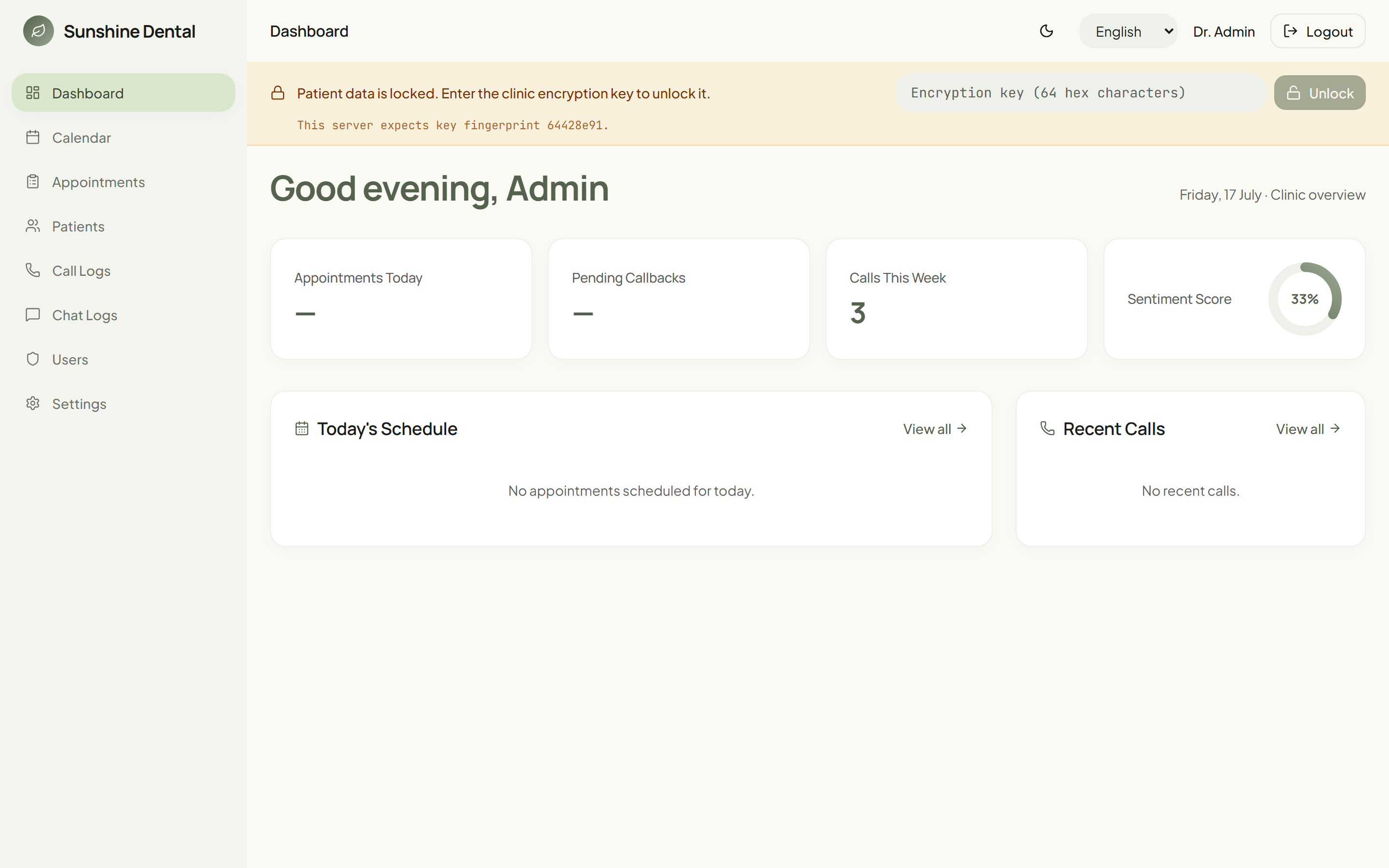
POST /api/admin/unlockwith the key; the key lives only in process memory. Every deploy or restart re-locks, and the admin does a 10-second unlock ritual. That ritual is the custody model — mildly annoying, entirely the point. - While locked, the app degrades instead of dying: login works, the calendar renders with
••••placeholders for titles, PII endpoints return a clean503 ENCRYPTION_LOCKED, and the patient chat says it's temporarily unavailable. Staff can work; nobody can read PII.
The canary: rejecting wrong keys before they poison anything
An unlock endpoint that accepts any 64-hex string is an unlock endpoint that will eventually accept a typo. The fix is a keycheck canary: on first unlock, a known plaintext is encrypted with the candidate key and stored in an AppSetting row. Every later unlock must decrypt that canary back to the known plaintext, or it's rejected with 400 Wrong encryption key — GCM's auth tag does the verification for free:
if (existing) {
  if (decryptWith(candidate.dataKey, existing.value) !== KEYCHECK_PLAINTEXT) {
    return false   // wrong key: rejected before touching any data
  }
} else {
  await db.appSetting.create({ data: { key: KEYCHECK_SETTING_KEY,
    value: encryptWith(candidate.dataKey, KEYCHECK_PLAINTEXT) } })
}
War story: the day the seed script re-keyed production
The canary has a flip side: whoever writes it first wins. Our seed script wipes tables and rewrites the canary from process.env.ENCRYPTION_KEY — and one day it was run with DATABASE_URL pointed at prod while a dev key was loaded in the shell. Result: prod silently re-keyed to the dev key, and the real, escrowed prod key started bouncing off the unlock endpoint with "Wrong encryption key". Nothing was lost (the data had been re-encrypted under the dev key, not destroyed), but the diagnosis took a while because the error reads like a typo, not like a re-key.
Two safeguards came out of that incident:
- The seed refuses non-local databases. It parses
DATABASE_URL, and anything that isn't localhost fails closed unless you passSEED_ALLOW_PROD=1— turning "accidentally nuked prod" into a deliberate two-step. - A key fingerprint — a non-secret 8-hex SHA-256 tag of the master key, stored beside the canary and surfaced on
/api/healthand in the unlock banner ("This server expects key fingerprint6b6114bd"). An operator can now tell which key a database expects before typing one. Publishing it is safe: it's infeasible to invert, and the canary is already an online oracle anyway.
Layer 4: escrow — one keypair, two jobs
"The vendor holds no key" has an ugly corollary: if the clinic loses the key, the data is gone. You need a recovery story that doesn't reintroduce vendor custody. The answer is a single age keypair, generated once at install on the clinic's machine:
age-keygen -o clinic-recovery.key # prints: Public key: age1…
- The private key is printed, sealed, and stored in two physical places (clinic safe + owner). It never touches a server.
- The public key is genuinely public — it goes in the server env, the repo docs, anywhere.
Job 1 — escrow the master key:
age -r "age1…" <<< "$MASTER_KEY" > master-key.age
master-key.age is useless without the sealed private key, so it can be stored anywhere — even by the vendor. Holding ciphertext of a key you cannot decrypt is not custody. Clinic loses the key → unseal the paper → age -d → unlock as normal.
Two alternatives were rejected on the way here. A vendor-held recovery KEK (classic envelope encryption) would make the vendor a data processor with PII access — a GDPR/DPA burden taken on to solve a problem that doesn't need it. And an automatic plaintext export ("just keep a CSV somewhere safe!") is self-refuting: automatic means it must decrypt, which means the key must be on the server, which is precisely the thing the whole model forbids. "Automatic" and "the vendor holds no key" are mutually exclusive for a plaintext export.
Job 2 — encrypt the backups. Same keypair, next section.
Layer 5: backups the server can create but never read
Nightly job, in full (trimmed of logging):
set -euo pipefail
STAMP="$(date +%F-%H%M)"
pg_dump -Fc --no-owner --no-privileges "$BACKUP_DATABASE_URL" \
  | age -r "$BACKUP_AGE_PUBKEY" > "sunshine-${STAMP}.dump.age"
# size sanity check — refuse to call a 300-byte stub a backup
# rclone → Hetzner Storage Box, prune > 90 days (remote + local)
curl -fsS --retry 3 "$HEALTHCHECK_URL"   # dead-man's switch: ONLY on success
The design points, each earned the hard way:
- Public-key encryption of the stream. The server holds only the
age1…public key, so a fully compromised VPS cannot decrypt a single historical backup. This is why not restic/borg: they'd introduce a repo password — a second secret, readable by the box, that itself needs escrow. Asymmetric crypto gives create-but-not-read for free, and a small DB gets nothing from dedup. - Whole-database dumps, never selective tables. The canary and the ciphertext must travel as a matched set — restore ciphertext against a different canary and you've manufactured the exact "Wrong encryption key" incident from the war story above.
- Fail loudly, ping late. Any failed step exits non-zero and skips the healthcheck ping, so the dead-man's switch (healthchecks.io) fires on missed runs, not just failed ones. A backup system's worst failure mode is silence.
- The dump is not fully ciphertext. Auth password hashes and session tokens are plaintext by design (the auth library owns them), so
ageencryption of the dump is not optional, and a decrypted restore artifact gets shredded after use. - It runs as a tiny
backupservice inside the same docker-compose stack as the app and Postgres (alpine+postgresql17-client+age+rclone), triggered by a Coolify Scheduled Task. It can't live in the API image —node:22-slimhas none of the tools, and puttingpg_dumpin your app container is how version-mismatch surprises happen. In-stack also means it reaches Postgres asdb:5432on the compose network: no public database port exists at all.
The drill — because an untested backup is not a backup
Before trusting any of this, I ran the whole loop as a fire drill against a scratch Postgres on the VPS: wrap the master key → unwrap it (byte-identical) → pg_dump | age the dev DB → decrypt → pg_restore into the empty scratch DB → point an API at it → confirm it boots locked → confirm a wrong key gets 400 and the DB stays locked → unlock with the real key → watch PII decrypt. Row counts matched on all 13 tables.
The drill also surfaced three things no amount of desk-checking would have:
pg_restoreexits non-zero on a benign error. Dumps taken from a managed Postgres (Prisma.io in our case) carryCREATE EXTENSION prisma_postgres, which vanilla Postgres can't satisfy. Data restores fully; the exit code still says 1. If your restore runbook (or your monitoring) treats any non-zero as fatal, a real 3 AM restore just got scarier for no reason. Now documented in the triage table.- The doc was stricter than the code. The runbook asserted a
keyfingerprintrow must exist post-restore; databases whose canary predates the fingerprint feature legitimately reportnull. The check would have "failed" a perfectly good restore. - Warnings on stderr are invisible in the scheduler's log view. Our "backup is LOCAL ONLY" warning goes to stderr — which Coolify's task log doesn't show.
[backup] OKin a log does not imply the offsite copy exists; verify the env, not the log line.
That's the actual value of a drill: not confirming the happy path, but finding the places where your documentation and your monitoring would have lied to you during a real incident.
Why pgcrypto isn't a good fit here
The most common "isn't this over-engineered?" question this design gets: Postgres ships pgcrypto — why not just pgp_sym_encrypt() the columns and delete all that application code? Because it quietly reverses the one sentence the whole design hangs on:
- The key travels to the database.
pgp_sym_encrypt(data, key)puts the key inside every SQL statement, so the DB server sees both key and plaintext — and statement logs,pg_stat_statements, and error messages become places your master key can land on disk. The attacker this design defends against (anyone with database access: a leaked dump, the hosting provider, the vendor) is exactly who pgcrypto hands the key to. "The server never holds the key" becomes "the database holds it, per query." - Weaker cryptography. pgcrypto has no AES-GCM.
pgp_sym_encryptis CFB mode with a SHA-1-based PGP integrity check; the rawencrypt()function is unauthenticated CBC/ECB. The GCM auth tag is what powers the wrong-key canary and tamper detection above — you'd be giving that up, not just swapping libraries. - No real simplification behind an ORM. Prisma can't express pgcrypto calls, so every read and write of every encrypted field becomes raw SQL — trading one small, grep-able
crypto.tsfor$queryRawscattered through every service. And sincepgp_sym_encryptis (correctly) non-deterministic, the blind index for phone lookups is still needed; its HMAC key would now also be shipped to the DB.
pgcrypto is a fine tool for a different threat model — one where the database is trusted and you want in-SQL convenience: password hashing with crypt()/gen_salt(), gen_random_uuid(), ad-hoc encryption in a pipeline. For "the DB and its operator must never see plaintext," encryption has to happen before the data reaches the database, which means the application layer.
Honest limits, again
- Root on the live box can read the key from process memory while unlocked. Encryption at rest protects stolen dumps/disks/backups/providers — real threats — not a hostile host.
- Runtime plaintext still flows to the LLM APIs powering the receptionist; that's a data-processing relationship to disclose, not something encryption at rest changes.
- Losing both the master key and the sealed recovery key means permanent data loss, by design. Mitigate with multiple sealed copies — never with a plaintext stash.
The checklist version
enc:v1:prefixed AES-256-GCM fields; HKDF subkeys; explicit service-layer encryption.- HMAC blind index for exact lookups; capped decrypt-and-filter for substring search.
- Boot locked; admin unlock; canary rejects wrong keys; fingerprint tells you which key.
- Guard every path that can (re)write the canary — especially your seed script.
- One clinic-held
agekeypair: escrows the master key and encrypts backups. - Nightly whole-DB
pg_dump | age -r <pubkey>; offsite; prune; dead-man's switch pinged only on success. - Drill the restore quarterly. Write down what the drill contradicts in your docs.
None of this needed a KMS, an HSM, or a security team — it needed one deliberate constraint ("the server never holds the key") and the discipline to follow its consequences all the way down to the backup script's exit codes.