
Booking and More — Guide to Completing Your Business Information
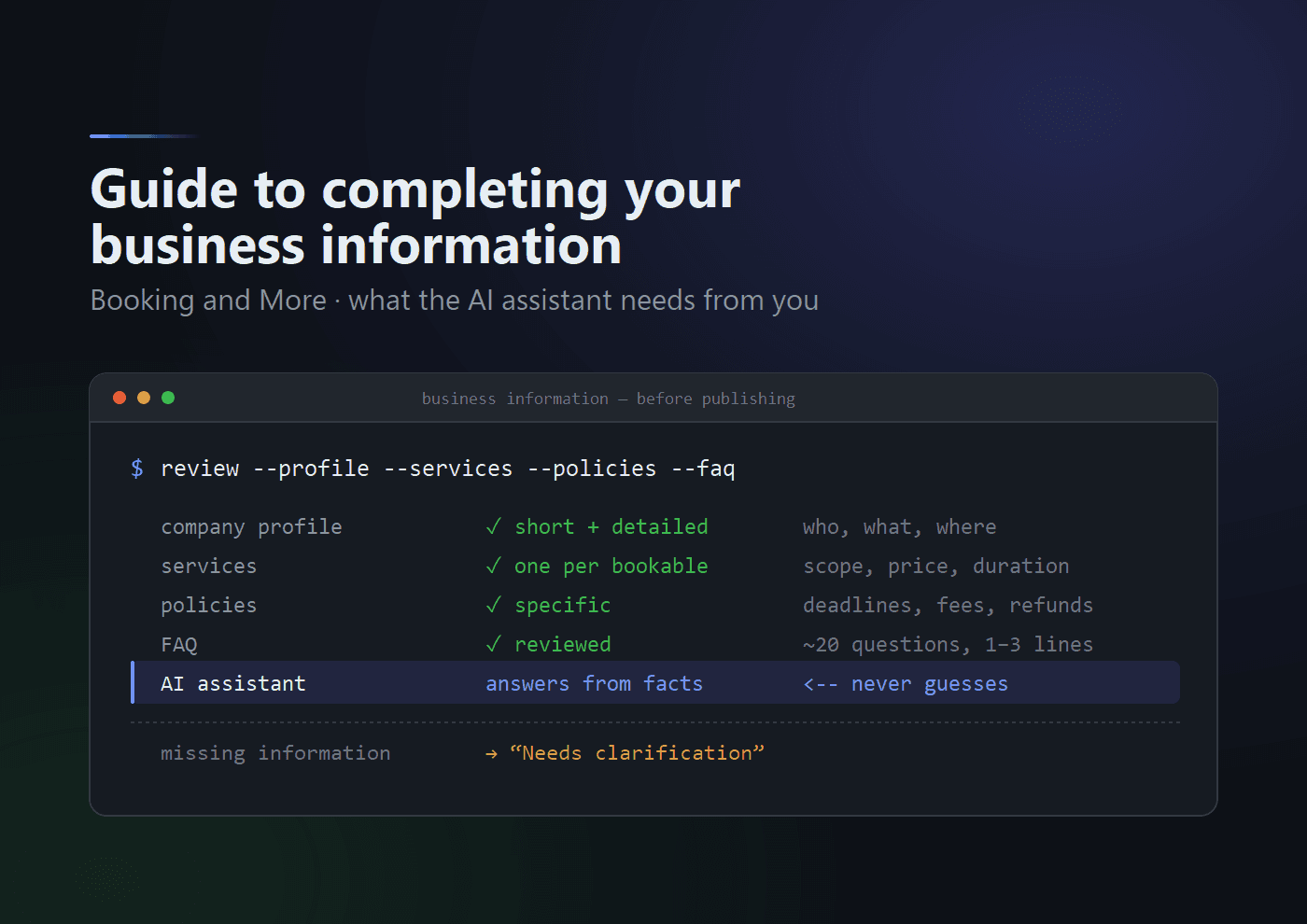
How to write your company profile, service descriptions, booking policies and FAQ so that customers — and the AI assistant answering them — get accurate, verifiable information. Templates, field checklists and a copyable FAQ-drafting prompt included.
Magyarul: Útmutató a vállalkozás adatainak kitöltéséhez
Why do accurate descriptions matter?
Your company profile, service descriptions and booking policies help customers choose your services. The AI assistant also uses this information to answer their questions. Accurate, up-to-date information reduces misunderstandings.
This guide applies to any service business. Complete only the sections relevant to your operations. Mark information that does not apply as “Not applicable”; do not guess missing information.
1. General writing guidelines
- Write in clear, factual English without promotional language.
- Use specific, verifiable statements. Instead of “comprehensive service”, list what is included.
- Mention only services, locations and options that are actually available.
- Avoid claims such as “the best”, “market leader” or “outstanding quality”.
- Do not promise guaranteed results unless you can deliver them in every case.
- State when something is conditional, optional, charged separately or requires prior discussion.
- Avoid technical terms, or explain them briefly.
- Avoid repeating the same information in several places. Where possible, keep prices and other changing information in dedicated data fields.
- Have the final text reviewed by the person responsible for it within your business. Specialist content should be approved by someone with relevant expertise.
2. Company profile
The company profile describes your business as a whole. Put the details of individual services in their own service descriptions.
Short profile — 2–3 sentences
Answer these questions:
- What does your business do?
- Who are your services for?
- Where or how do you provide them?
Template:
[Business name] provides [main services] for [customer group]. We serve customers [at our location / within our service area / online]. To use our services, customers need to [book an appointment / contact us in advance].
Detailed profile — usually 100–200 words
Include only relevant information:
- Activities: what are your main service areas?
- Customers: do you serve individuals, businesses or specific groups?
- Delivery: do you work at your premises, online or at customers’ locations?
- Approach: how do you work, and what do you focus on?
- Professional background: what verifiable experience, qualifications or authorisations do you have?
- Getting started: how does a customer begin working with you?
Explain your values through specific practices, such as: “We provide a written quotation before starting work.” Mention qualifications, awards or certificates only when supported by facts. Do not imply that every team member holds a qualification if it applies only to certain people.
Business information — in separate fields
| Field | What to provide |
|---|---|
| Name | Display name and registered business name, if different. |
| Contact details | Website, customer service telephone number and email address. |
| Locations | Exact addresses and the services available at each location. |
| Service area | The area covered by visits to customers and any restrictions. |
| Opening hours | Appointment hours and customer service hours, if different. |
| Languages | The languages in which you can serve customers. |
| Access | Parking, entry instructions and accessibility, where relevant. |
| Customer support | Contact details for bookings, changes and complaints. |
If you have several locations, clearly indicate which information applies to each one.
3. Individual service descriptions
Give every service that can be booked separately a clear name and its own description.
Short description — 2–3 sentences
- What is the service?
- Who is it for, and what need does it address?
- What does the customer receive, and is an initial assessment required?
Template:
[Service name] addresses [need or problem] for [target customers]. The service includes [main activity or deliverable]. It requires [prerequisite, if any].
Long description — usually 100–200 words
Include only necessary details. Do not add text just to reach the suggested length.
- Purpose: what need or problem does it address?
- Scope: what is included, and what is excluded?
- Process: how does it work, and what does the customer need to do?
- Preparation: what should the customer bring, send or prepare?
- Outcome: what result or deliverable can the customer expect?
- Follow-up: are further appointments or actions required?
- Individual differences: what depends on the customer’s needs or the initial assessment?
Distinguish between consultation, assessment and delivery of the service. If the first appointment is only a discussion, say so clearly.
For healthcare or other specialist services, have the appropriate professional specify relevant prerequisites, limitations and follow-up instructions. A general description should not replace an individual professional decision.
Information to provide for each service
| Field | What to provide |
|---|---|
| Price and currency | Fixed price, starting price, hourly rate or individual quotation. |
| Price inclusions | What is included and what is charged separately. |
| Duration | The length of the booked appointment and whether multiple sessions are needed. |
| Completion | The completion or delivery deadline, if different from the appointment duration. |
| First appointment | Consultation, assessment, delivery of the service or a combination. |
| Location and provider | Where and with whom it can be booked; whether online sessions or visits to customers are available. |
| Prerequisites | Required documents, assessments, prior discussions or other conditions. |
| Participants | Individual or group service; participant limits and age requirements. |
| Preparation | What the customer must do beforehand or bring along. |
If a detail cannot be specified in advance, use wording such as “Prior discussion required” or “Subject to an individual quotation”.
4. Booking and operating policies
Make policies specific and available to customers before booking. State general policies once; clearly identify any conditions that differ by service or location.
| Topic | Questions to answer |
|---|---|
| Booking | How can customers book? Is confirmation immediate, or is provider approval required? |
| Prior discussion | Which services require a consultation or assessment beforehand? |
| Arrival | When should customers arrive? What happens if they are late? |
| Payment | When, in which currency and by which methods can customers pay? |
| Advance payment | Is it required? How much is it, when is it due, and how is it credited towards the final bill? |
| Rescheduling | How and by what deadline can an appointment be changed? |
| Cancellation | How and by what deadline can it be cancelled? What fees or refunds apply? |
| Missed appointments | What happens if a customer does not attend and has not cancelled? |
| Provider cancellation | How will the customer be notified, and what alternative appointment or refund will be offered? |
| Contact and complaints | Whom can the customer contact, and through which channel? |
Avoid vague wording such as “Cancel in good time”. Instead, specify the deadline, contact channel and consequences. Also state the conditions for refunding advance payments.
5. Frequently asked questions — FAQ
The FAQ should help customers make real decisions and resolve practical uncertainties. Around 20 questions is a reasonable starting point; fewer are fine if there are no further useful topics.
- Include questions about the business, booking and individual services.
- Use the everyday language your customers use.
- Name the service in questions about a specific service.
- Keep answers to roughly 1–3 sentences and make them understandable on their own.
- Avoid promotional questions such as “Why are we the best?”
- Ensure answers agree with service information and booking policies.
- Review and approve AI-generated answers before showing them to customers.
Copyable prompt for drafting FAQs
Copy the following prompt into an AI tool, such as ChatGPT, and insert your approved business information. Customer personal data is not needed.
Using the company profile, service descriptions and operating policies
below, create approximately 20 frequently asked customer questions
and draft answers for the business’s FAQ section.

Goal: help customers decide which service suits them, how to book
and what to expect.

Rules for questions:
- Write in natural, everyday English from the customer’s perspective.
- Address real decisions and practical uncertainties.
- Include both general and service-specific questions.
- Where relevant, cover choosing a service, booking, the first
  appointment, preparation, price, payment, duration, location
  and cancellation.
- Name the service in service-specific questions.
- Do not repeat the same question in different words.
- Avoid promotional questions.
- Do not force 20 questions if fewer useful questions emerge.

Rules for answers:
- Use only the information provided.
- Keep answers brief, direct and understandable on their own,
  usually 1–3 sentences.
- Do not invent prices, conditions, services, guarantees
  or professional claims.
- If information is missing, write “Needs clarification” and specify
  what information the business must provide.
- Flag conflicting information; do not choose arbitrarily.
- Do not claim that appointments are available; availability must
  be checked in the booking system.

Present the results in a table with these columns:
1. Topic or service
2. Customer question
3. Draft answer
4. Status: “Supported by the supplied information”
   or “Needs clarification”

At the end, list missing or conflicting information without repetition.

SOURCE INFORMATION

Company profile:
[Paste here.]

Service names, descriptions and details:
[Paste all services here.]

Booking and operating policies:
[Paste here.]
6. AI assistant response principles
The assistant should use approved information according to these principles:
- Answer questions about the business’s offerings and conditions using only the supplied information.
- Do not invent prices, durations, discounts, professional experience, qualifications or service commitments.
- Answer questions about a particular service using its own description and conditions.
- Do not automatically apply information about one location or staff member to others.
- Do not infer appointment availability from opening hours; check the booking system.
- State that a booking has been completed only after successful confirmation from the system.
- Do not promise that the service will be delivered at the first appointment unless this is specified.
- Do not agree to special requests, exceptions or guaranteed outcomes without provider approval.
- If information is missing or conflicting, explain that clarification is needed and provide the appropriate contact details.
- If a request goes beyond the described service, ask for clarification or refer the customer to the appropriate staff member.
7. Checklist before publishing
- The short and detailed company profiles are complete.
- Every bookable service has a clear name and its own description.
- The purpose of the first appointment and any prerequisites are clear.
- Prices, inclusions and additional charges are clear.
- Appointment duration is distinguished from any completion deadline.
- Payment, rescheduling, cancellation and missed-appointment policies are specific.
- Locations, contact details and opening hours are up to date.
- FAQ answers have been reviewed and contain no “Needs clarification” labels.
- There are no contradictions between the company profile, service information, policies and FAQ.
- The responsible person has approved the content.
When something changes, update the relevant data fields and any descriptions or FAQ answers containing the same information. Assign someone responsibility for maintaining the information.